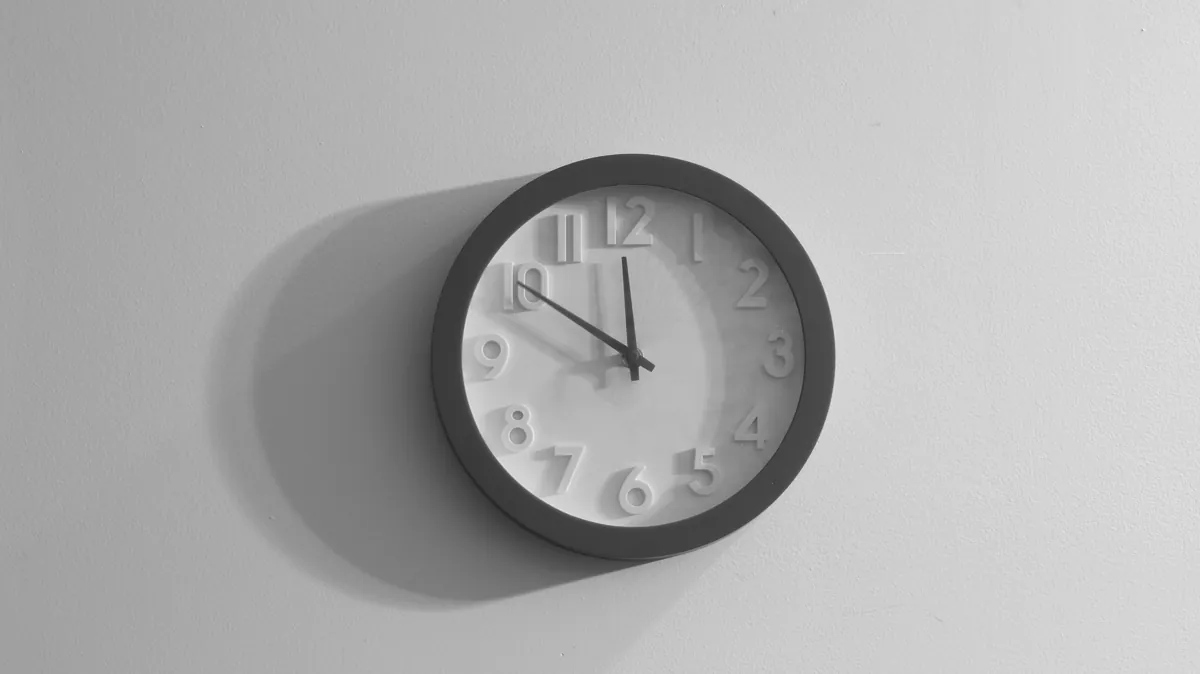
The short answer
By the convention almost everyone now follows, 12:00 PM is noon and 12:00 AM is midnight. Midday is PM; the dead of night is AM. If you remember one thing from this article, remember that line.
The trouble is that this neat answer sits on top of a genuinely awkward problem. Noon and midnight are the only two moments where the 12-hour clock quietly contradicts its own logic, which is why even careful writers, lawyers, and airlines tiptoe around them. To see why, it helps to know what AM and PM were ever meant to say.
What AM and PM actually mean
AM and PM are abbreviations of Latin. AM stands for ante meridiem, “before midday.” PM stands for post meridiem, “after midday.” (Note the spelling: it is meridiem, not “meridian,” although the two words share an ancestor.) The shared word is meridies, midday — the same root that gives us the meridian, the imaginary north–south line the Sun crosses when it is highest in the sky.
So the whole 12-hour clock is built around a single pivot: local noon, the instant the Sun reaches its peak. Everything before that instant is ante meridiem; everything after it is post meridiem. The day is sliced into two halves of twelve hours each, and every hour number from 1 to 12 gets used twice a day — once with AM, once with PM. That reuse is exactly why we need the labels at all, and exactly why the two boundary moments cause trouble.
Why noon and midnight break the rule
The system is perfectly clear for every minute except two. The problem is that AM and PM describe a position relative to noon, and the two moments in question sit right on the dividing lines.
Noon is the meridiem. It is not before midday and not after midday — it is midday itself. Labelling it “12 PM,” which literally means “12 after midday,” is a small contradiction. Midnight has the mirror problem: it falls exactly twelve hours from noon, on the seam between one calendar day and the next, belonging cleanly to neither the evening that just ended nor the morning about to begin.
This is not a modern quibble. Older American style guides avoided “12 PM” and “12 AM” altogether and wrote 12 M. for noon — the M standing for meridies — precisely because the AM/PM labels do not fit the boundary. The convention we use today (noon = PM, midnight = AM) is a practical decision layered on top of a system that never had a clean answer for those two instants.
The convention, and how to remember it
So how did 12 PM come to mean noon? The usual way to rationalise it is to treat the stroke of 12 as the start of the next twelve-hour block rather than the end of the last one. One second after 12:00 midday you are clearly in the afternoon — post meridiem — so the whole minute starting at 12:00 is labelled PM. One second after 12:00 midnight you are clearly in the small hours of the morning — ante meridiem — so that minute is labelled AM.
A simple memory aid: the Sun reaches its Peak at noon, so noon is PM. Midnight, its opposite, is therefore AM. Here is the full picture in one table:
| Moment | 12-hour clock | 24-hour clock |
|---|---|---|
| Midnight | 12:00 AM | 00:00 |
| 1:00 in the morning | 1:00 AM | 01:00 |
| 11:00 in the morning | 11:00 AM | 11:00 |
| Noon | 12:00 PM | 12:00 |
| 1:00 in the afternoon | 1:00 PM | 13:00 |
| 11:00 at night | 11:00 PM | 23:00 |
Notice the quirk in that middle of the table: the hour jumps from 11 AM straight to 12 PM, then back down to 1 PM. The “12” sits out of sequence, which is another reason the noon and midnight slots feel wrong even when they are technically correct.
Why this small ambiguity causes real problems
Because so many people are unsure, “12 AM” and “12 PM” are genuinely risky to write down. The confusion has practical consequences:
- Contracts and insurance. A policy that starts “at 12:00 AM on the 1st” can be read as the midnight beginning the 1st or the midnight ending it — a full day apart. Many contracts deliberately write 11:59 PM or 12:01 AM to remove the doubt.
- Flights and timetables. Airlines generally avoid scheduling departures at exactly 12:00 AM, using 11:59 PM or 12:01 AM instead, so passengers do not arrive a day early or late.
- Opening hours. “Open until 12 AM” leaves customers guessing whether that means tonight’s midnight or noon. “Open until midnight” is unambiguous.
- Deadlines. A submission “due by 12 AM Friday” is a classic trap: some people aim for the start of Friday, others for the start of Saturday.
The fix is easy. The US National Institute of Standards and Technology points out that 12 AM and 12 PM are inherently confusing, and recommends writing 12 noon and 12 midnight instead — or, better still, switching to the 24-hour clock. When the time matters, spell out “noon” or “midnight,” nudge it to 11:59 or 12:01, or use 24-hour notation.
Midnight: the end of one day or the start of the next?
Midnight carries a second, deeper ambiguity that noon does not: it is not just a time, it is a seam between two dates. “Midnight on Friday” can mean the midnight that opens Friday or the one that closes it. By today’s civil convention midnight is treated as the start of the new day, which is why your phone rolls over to the next date at 12:00 AM — but that was a real historical choice, not a law of nature, and you can read the full story in our piece on how midnight became the start of the day.
The international standard sidesteps the whole mess. ISO 8601 uses 00:00 for the midnight that begins a day and allows 24:00 for the midnight that ends it, so 24:00 on one date and 00:00 on the next describe the same instant while making it crystal clear which day you mean.
The 24-hour clock removes the doubt
The cleanest way to avoid the noon-and-midnight problem is to drop AM and PM entirely. The 24-hour clock numbers the hours straight through from 00:00 at midnight to 23:59 at the last minute of the day. There is no repeated 12, no need for a label, and no boundary the system cannot name: midnight is 00:00 and noon is 12:00, full stop.
Converting is straightforward. From midnight to noon, the two clocks agree except for the label, so 9 AM is 09:00. After noon, add 12 to the hour: 1 PM becomes 13:00, 5 PM becomes 17:00, 11 PM becomes 23:00. The only two you have to memorise are the awkward ones — 12 AM is 00:00 and 12 PM is 12:00 — and once you use 24-hour time you never have to think about them again.
This is why the 24-hour clock dominates anywhere mistakes are expensive: the military (where 09:00 is spoken “zero nine hundred” and midnight is often “zero hundred hours”), hospitals and pharmacies, aviation, the railways that popularised it, science, and almost all of computing. It is also the everyday written standard across most of continental Europe, Latin America, and much of Asia and Africa, while the 12-hour AM/PM clock remains the conversational default in the United States, Canada, the UK, Australia, and a handful of other mainly English-speaking places.
Why we have 12 hours in the first place
If the 24-hour clock is so tidy, why did we ever split the day into two twelves? The answer is thousands of years old. The ancient Egyptians divided daylight into 12 parts, tracked by the shifting shadow of a sundial, and divided the night into 12 more using the rising of certain stars. Twelve was a natural unit for them partly because of finger-counting: using the thumb to tap the three joints of each of the other four fingers gives exactly twelve counts on one hand.
The Babylonians layered their base-60 mathematics on top, which is why an hour has 60 minutes and a minute has 60 seconds. The 12-and-60 structure we still use is a fossil of those two ancient systems. (A smaller fossil hides in the word “noon” itself: it comes from the Latin nona hora, the “ninth hour” of the Roman day, which originally fell in mid-afternoon before the name drifted earlier to mean midday.)
How to write the time so nobody is confused
- For ordinary times, AM and PM are fine: 8:30 AM and 6:00 PM are clear to everyone.
- For the two tricky moments, write noon and midnight in words rather than 12 PM or 12 AM.
- When a deadline or contract hangs on the exact instant, use 11:59 PM or 12:01 AM, and name the date explicitly.
- For anything international, technical, or safety-critical, prefer the 24-hour clock, and add the time zone if readers are in different places.
Check the time with confidence
AM and PM are a 2,000-year-old shortcut that works beautifully for 1,438 minutes a day and stumbles on just two. Now you know why: they measure time relative to noon, and noon and midnight are the one place where “before” and “after” run out of meaning. When in doubt, say the word, or count straight through to 24.
You can always confirm the current moment — in both 12- and 24-hour form — on our what time is it page, compare it across cities on the world clock, or double-check the calendar with today’s date.