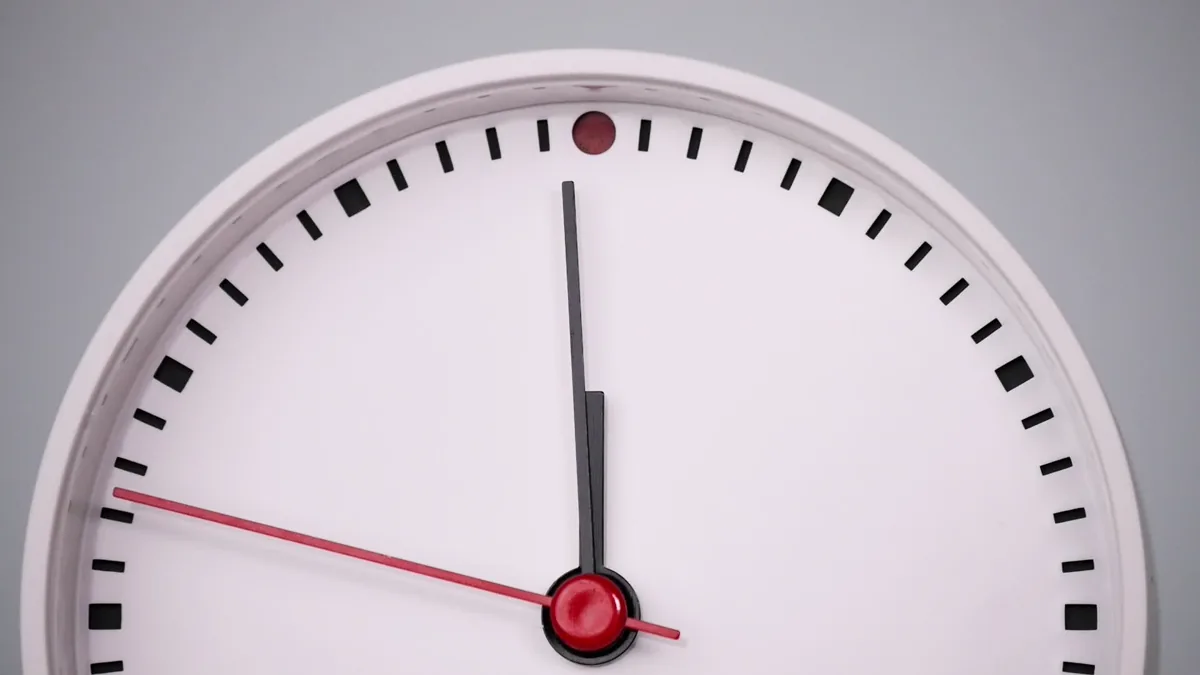
Midnight is a strange place to begin
If you were designing time from scratch, midnight would not be the obvious starting point. Nothing visible happens in the sky. The Sun is not rising, setting, or crossing the meridian. Most people are asleep. Yet in modern civil time, the date changes at 00:00, not at dawn, not at sunset, and not at noon.
That choice feels natural only because clocks made it natural. For most of human history, the day was not a clean abstract block of twenty-four equal hours. It was an experience of light and darkness, work and rest, ritual and law. Different societies answered a simple question in different ways: when does one day stop being today and become tomorrow?
Older days began at visible moments
The most intuitive boundaries are sunrise and sunset. A sunrise day matches the practical rhythm of farming, travel and labor: the day begins when people can see and work. A sunset day matches the religious and social rhythm of evening observance: the new day begins when the previous daylight has ended.
That is why ancient and traditional systems did not agree. Jewish and Islamic days are classically reckoned from sunset. Some ancient Greek practice also used sunset. Other traditions counted from sunrise. These systems were not primitive mistakes. They were attached to events that ordinary people could actually observe without a clock.
Midnight, by contrast, is invisible. It is not a natural spectacle. It is a calculated point: halfway between one noon and the next, opposite the Sun’s highest daily point. You need either theory, instruments, or a reliable clock to treat it as a public boundary.
Noon was the first precise anchor
Noon was easier to define than midnight. With a sundial or a marked meridian line, local noon occurs when the Sun reaches its highest point and shadows are shortest. That made noon the most measurable moment in the day long before mechanical clocks were accurate.
This is one reason astronomers historically liked noon. A night of observations crosses midnight; if the astronomical day begins at noon, the whole night can keep the same date. That was convenient for logbooks and star observations. In civil life, however, a noon date change is awkward. Contracts, markets, travel and daily administration do not want the date to flip halfway through the working day.
The modern world eventually separated those needs. Astronomy could use specialized time scales when necessary. Civil society needed one date boundary that was quiet, regular and unlikely to interrupt business.
Rome helped make midnight a legal boundary
The Romans are one of the important steps in the story. Roman civil practice treated the legal day as running from midnight to midnight, even though ordinary life still responded to sunrise, daylight and seasonal hours. Midnight gave law a clean boundary: a date could begin while public activity was minimal, before markets, courts and official business resumed.
This legal usefulness matters. Calendars are not just astronomy. They are administration. They decide when a debt is due, when a festival begins, when an office term starts, when a birth or death is recorded, and which date belongs on a document. A boundary that falls in the middle of the night is socially convenient because fewer public actions happen exactly then.
That does not mean everyone immediately lived by midnight. Medieval Europe still contained local and religious ways of counting hours. In parts of Italy, for example, hours were counted from sunset for a long time. Monasteries organized life around canonical hours. Town clocks, church bells and local custom mattered more than a universal 00:00.
Mechanical clocks made midnight practical
The decisive change was not just a philosophical preference. It was technology. Mechanical clocks spread through European towns from the late medieval period onward, and they encouraged the idea of a day made from equal, countable hours. Once a clock face can divide time continuously through the night, midnight becomes a repeatable public event rather than an invisible assumption.
Equal hours were a major shift. In many older systems, daylight and nighttime could each be divided into twelve parts, so an “hour” changed length with the seasons. A summer daylight hour was longer than a winter daylight hour. Mechanical clocks favored equal hours because gears and escapements do not stretch and shrink with daylight.
As clock time became more important for cities, trade, transport and government, midnight gained strength as the neutral reset point. It sat opposite noon on the dial, it happened when most official business was closed, and it let a calendar date cover a complete waking day from morning through evening.
Railways and standard time finished the job
Local time once varied from town to town because noon depended on the Sun’s position at each longitude. That was tolerable when travel was slow. It became a problem when railways and telegraphs connected cities. A train timetable cannot work cleanly if every station uses a slightly different local day and local noon.
The nineteenth century pushed timekeeping toward standard zones, national time laws and international coordination. Once countries adopted standard time, the midnight boundary became even more useful. “00:00 on Monday” could be understood across a whole zone, printed in timetables, used by offices and eventually processed by computers.
Modern standards still preserve a small trace of the old ambiguity. ISO 8601 allows 00:00 for the beginning of a calendar day and, in some contexts, 24:00 for the end of one. That is a neat way to express what midnight really is: both the instant one date ends and the instant the next one begins.
Why midnight won
Midnight won because it solved a civic problem better than sunrise, sunset or noon. Sunrise and sunset move through the year and vary by location. Noon cuts the working day in half. Midnight is stable on a clock, quiet in public life and symmetrical within the twenty-four-hour cycle.
It is not the most poetic beginning. Dawn feels like a beginning. Sunset feels like a boundary. Midnight feels like an agreement. But that is exactly why it works. A calendar date is not only a natural fact; it is a shared convention. The modern day starts at midnight because societies needed a clean legal and administrative switch, and clocks finally made that invisible moment easy for everyone to use.
Further reading
- Encyclopaedia Britannica: Day
- Encyclopaedia Britannica: Calendar
- NIST: Time of Day FAQs
- Richards, E. G. Mapping Time: The Calendar and Its History (Oxford University Press, 1998).